
Good News
Extended Producer Responsibility is going beyond an environmental policy objective. It's on its way to becoming a structural industry standard.
The EPR wave is here and it's commanding the swirl of the market economy
California's SB 54 set the precedent: producers of single-use packaging are required to join a Producer Responsibility Organization, hit 65% recycling rates by 2032, and pay $500 million annually into an environmental mitigation fund through 2037. This framework, geared to shift product production towards a greener future, has become the blueprint for other state mandates to follow.
Maine, Oregon, Colorado, and California have all initiated active packaging EPR programs. SB 707 extends the framework to textiles such that apparel and home goods producers must now fund collection, repair, and recycling infrastructure. Oregon's program just published its first quarterly reports, with Circular Action Alliance managing producer payments and expansion funding. Not only do the effects speak for themselves, but the advance towards a production infrastructure that promotes a cycle of product life is an indication of the positive direction the economy is heading in.
The result of the shift is unmistakable: recycling costs are moving from taxpayers to producers. Municipalities get reimbursed. Infrastructure gets funded. And goods that might have been destroyed now have a regulatory pathway to communities instead. Donation is more than just a good deed, it's strategic route to efficient business.
Not everyone is celebrating. Industry groups are filing constitutional challenges in Colorado and Oregon, citing disproportionate burdens on small businesses. A lubricant manufacturers' association calls fees "an existential threat." But with seven states now on board and more legislation advancing, the trajectory is clear. As always and by its very nature, umbrella legislation cannot account for every nuance. While small businesses are an integral part of our society and account for 43.5% of the U.S.'s GDP according to the U.S. Chamber of Commerce, we are reminded that success is often determined by ability to adapt. In our world that is pointing in the direction of sustainability, this may mean an anticipatory shift towards greener practices for businesses of all sizes.
For nonprofits: Corporate partners are rethinking supply chains, product donation, and where to direct giving. The organizations that understand EPR pressures will be better partners — and better positioned to receive excess inventory that producers now have compliance reasons to donate rather than destroy. The structure of large scale donation is about to be modernized, and non-profits ready to work with companies to make the transition smoothly will reap the benefits.
Clean energy just had its best year ever. The future is murkier.
World Resources Institute reports that 90% of new U.S. energy capacity in 2025 came from solar, wind, and storage — 56 gigawatts total, equivalent to powering New England twice over. Renewables now generate 26% of all U.S. electricity when you include rooftop solar. Wind and solar alone outpaced coal for the first time.
But the story doesn't just end there. Coal generation rose 13% as gas prices spiked. Data center developers announced 50 GW of behind-the-meter projects with nearly half powered by natural gas. Additionally, with the passage of H.R. 1, federal tax credits for wind and solar are eliminated unless construction begins by July 2026.
Yet, simultaneously, we see growth trends towards clean energy in big tech. The hyperscaler paradox is real: Google, Microsoft, and Meta are all signing massive clean energy PPAs and funding new gas plants to power AI infrastructure, a known entity responsible for significant energy usage. Google just committed to 6 GW of nuclear, and 900 MW of natural gas for a Texas data center.
The takeaway: The clean energy transition is accelerating and fragmenting at the same time. Keep eyes out for utility-scale solar and storage, which remain eligible for credits through 2032. And watch the states: California's climate disclosure deadline hits August 10.
In Indonesia, community-led design is transforming informal settlements
WRI's profile of Makassar shows what happens when infrastructure meets participatory design. The RISE program — Revitalizing Informal Settlements and Environments — has improved sanitation for 1,400 residents directly and 6,000 indirectly through nature-based wastewater treatment, raised pathways, and rainwater systems.
The approach itself is worth noting: researchers used randomized controlled trials across 12 settlements to measure actual health outcomes. Residents co-designed where wetlands, walkways, and drainage would go. Children's play areas emerged where contaminated floodwater once pooled. Researchers actively called on the communities they're impacting to gain a stronger understanding of the work they're doing and the improvements that were most necessary. This kind of collaboration is a prime example of what recipient participation can accomplish.
The model is scaling. With the success of this first round, there is more work to be done with high hopes of continued benefit. Makassar's government has identified 30 additional settlements for upgrades. Demonstration sites are live in Fiji and RISE-inspired strategies are now being applied along Indonesia's heavily polluted Citarum River.
Why this matters for nonprofits: The RISE program proves that evidence-based, community-led infrastructure can scale when it centers local ownership and builds municipal capacity. It's a template for how development organizations can move from pilot to system change. NPOs strive to improve lives and bring about increased equality and hope across the globe. By working directly with affected parties, organizations have the opportunity to create and affect real change that aids in areas they're needed most.
The UK is cutting foreign aid to its lowest level in decades
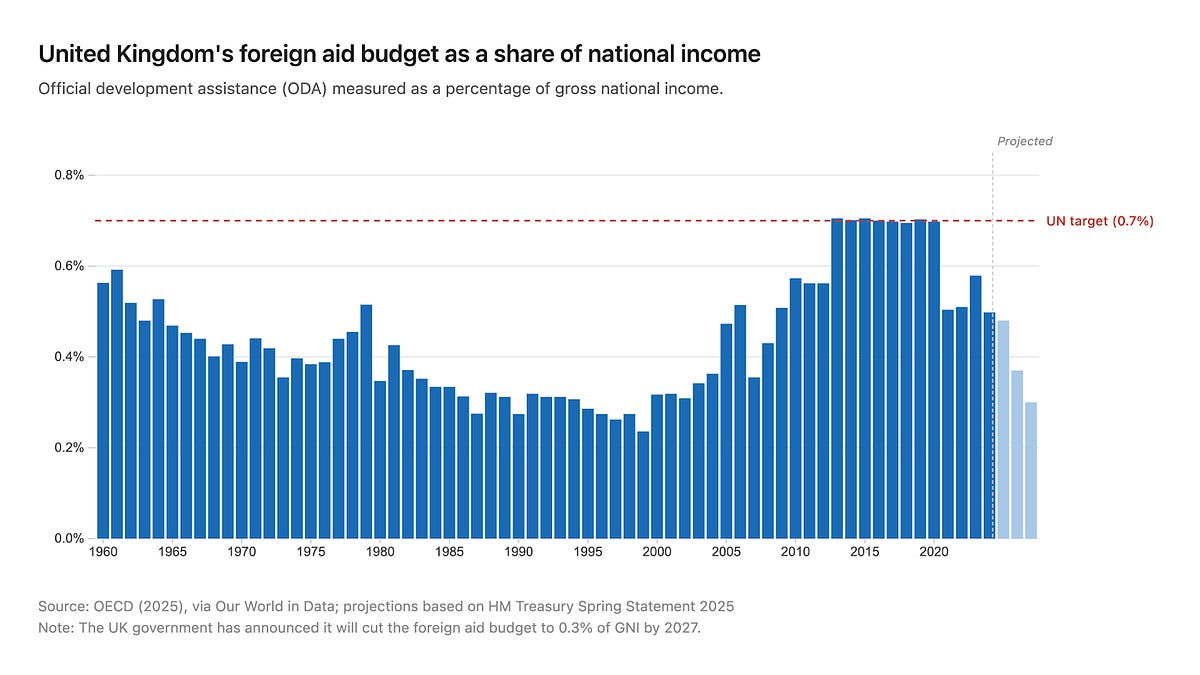
Hannah Ritchie's analysis puts the numbers in stark context: the UK is dropping from 0.5% of GNI to 0.3% by 2027, which is the lowest since 1999. When adjusted for domestic spending on refugee hosting, overseas development funding falls to approximately 0.24% of GNI.
The cuts are happening under a Labour government that once pledged in its 2024 manifesto to restore aid to 0.7%. The caveat — "as soon as fiscal circumstances allow" — appears to have been the exit clause.
The comparative picture: The UK met the 0.7% UN target under Conservative governments throughout most of the 2010s. It's now set to slip below France, Germany, and most Western European peers.
Ritchie's personal response: she gives 10% of her income to cost-effective charities through the Giving What We Can pledge. Small donations won't cover tens of billions in cuts, but they save lives at the margin.
Quick Hits
The EU formally adopted a 90% emissions reduction target for 2040: the most ambitious binding climate goal in the bloc's history. At least 85% must come from domestic cuts; up to 5% can use international credits.
CARB is weighing three options for Scope 3 reporting under California's climate disclosure law: full disclosure, sector-based phase-in, or category-based rollout. Compliance costs could run $120K–$190K annually. Comments close April 12.
AI may reshape career pathways for millions of non-degree workers who built careers through apprenticeships, military service, or on-the-job training. Brookings warns that entire ladders, not just individual jobs, could be disrupted.
Federal deregulation isn't simplifying compliance, it's fragmenting it. Retailers face a "regulatory tsunami" of state-level PFAS restrictions, EPR laws, and sustainability labeling requirements with varying definitions and timelines.
China stands to dominate the clean energy market as the Iran war accelerates global renewable transitions. Chinese manufacturers control supply chains for solar, batteries, and EVs, leading to a surge in exports in early 2026.
See something we should cover? Hit reply.
— The Simpli Team
Bill Text - SB-54 Solid waste: reporting, packaging, and plastic food service ware.
leginfo.legislature.ca.gov
Bill Text - SB-707 Responsible Textile Recovery Act of 2024.
leginfo.legislature.ca.gov
Department of Environmental Quality : Plastic Pollution and Recycling Modernization Act : Recycling : State of Oregon
oregon.gov
🟢 Extended Producer Responsibility Sweeping the US
packagingdive.com

Despite Unprecedented Challenges, Clean Energy Is Still Growing in the US. The Future Is More Uncertain.
Data shows that 90% of new energy capacity added in the U.S. last year came from clean sources, but fossil fuels are also growing.
wri.org

In This Indonesian City, Community-Led Design Is Improving Water and Sanitation
In Makassar’s informal settlements, community-led design and nature-based infrastructure are turning flood-prone neighborhoods into healthier, safer places to live.
wri.org
The UK is cutting its aid budget to the lowest level in decades
After pledging to increase the budget to 0.7% of GNI, the government is cutting it to 0.3%.
hannahritchie.substack.com
🟢 Extended Producer Responsibility Sweeping the US
consilium.europa.eu
California’s Scope 3 Trilemma
CARB outlines Scope 3 emission reporting options, EFRAG pushes voluntary reporting standards, and there is a blip in US reporting trends.
sustainabilitysimplified.eco
How AI could disrupt job mobility
connect.brookings.edu

NRF | Lawyers say federal deregulation makes compliance more challenging as states step in
Businesses run the risk of overpromising and underdelivering
nrf.com

China stands to benefit most from war-driven energy crisis
China’s renewable energy sector is set to benefit as the Iran war drives global demand for solar, batteries and EVs amid fossil fuel volatility.
finance-commerce.com
Enjoyed this post?
Subscribe to our newsletter and get our latest insights on product donation, social impact, and the platform delivered straight to your inbox.